Ascending Tiger Painting: Meaning, Feng Shui and Where to Hang It
TigerVow Studio Official
· 1 views
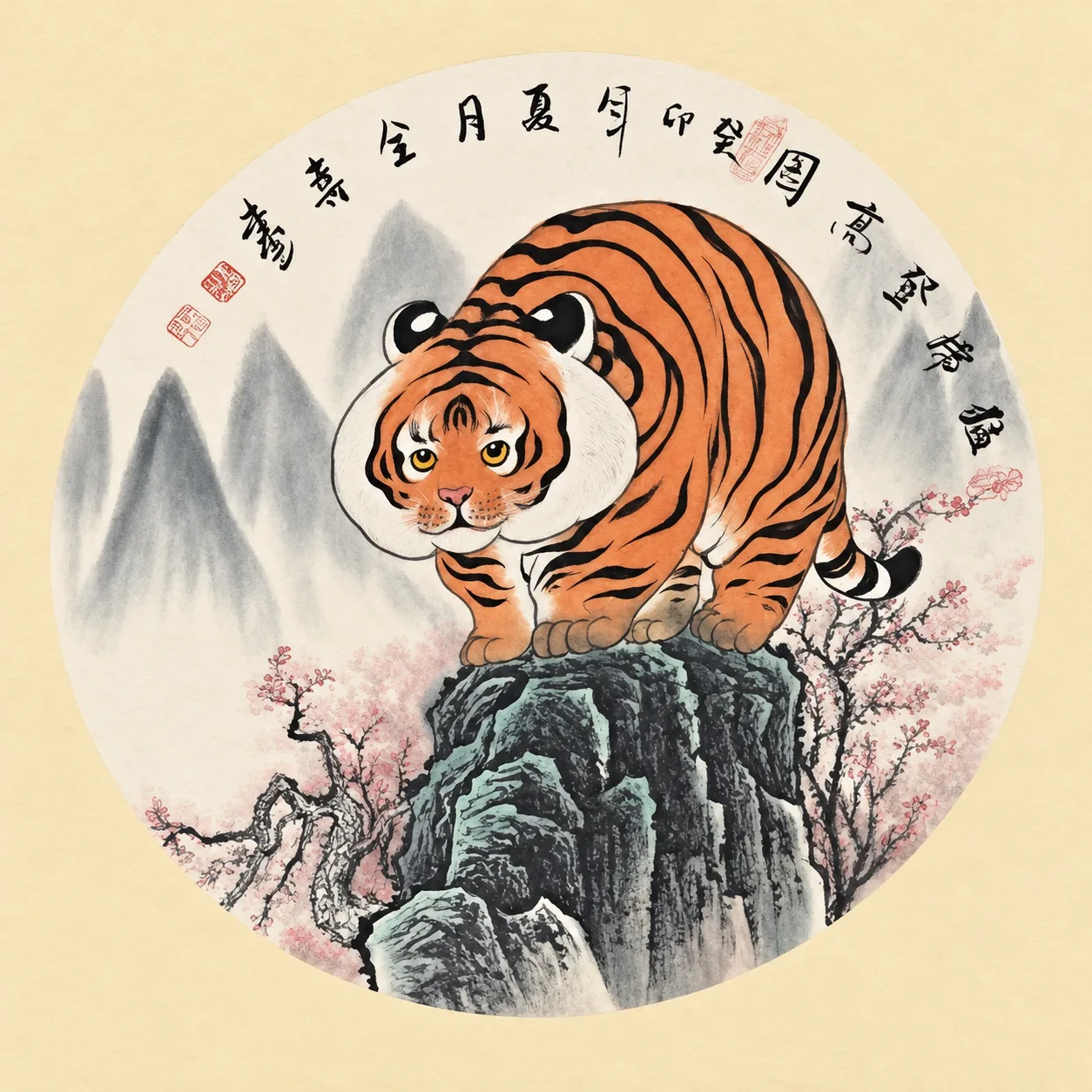
The tiger that walks uphill
In Chinese painting a tiger's pose carries meaning, and one of the most familiar distinctions is between the ascending tiger and the descending tiger. An ascending tiger is shown walking upward, usually with a calm, unhurried gait, its head level or lifted slightly. A descending tiger comes down the slope, often with its mouth open.
The ascending tiger is the subject of the painting discussed here. Its posture is the point. The animal is not attacking, not roaring, not startled; it moves up a path with the settled air of an animal that expects to arrive.
Reading the imagery: pine, rock and cloud
The tiger rarely travels alone. In a traditional ascending-tiger composition it is accompanied by landscape elements, each carrying its own associations.
Pine
The pine is the standard companion of the ascending tiger. It keeps its needles through winter, and in Chinese art it has long been associated with endurance and with long life.
Rock and mountain
The rock beneath the tiger's paws gives the ascent something to be measured against. Mountain paths in Chinese painting are rarely easy going; the slope is what gives the progress its meaning.
Cloud
Cloud and mist mark altitude, and the passage between one level of a mountain and the next. They suggest distance and quiet, and they soften the hard edges of rock so that the climb has room to breathe.
Technique: gongbi and a moving animal
The painting is executed in gongbi, the fine-brush mode: an ink outline first, then thin repeated washes of ink and mineral pigment, then fur drawn stroke by stroke along the body. For an ascending tiger the method matters to the reading of the pose. The outline fixes the angle of the climb, and the fur work shows the weight settling through shoulders and haunches as the animal steps. A gongbi tiger is built slowly, and that slowness is visible in the density of the coat.
What the ascending tiger is associated with
In traditional Chinese culture the ascending tiger is associated with steady progress: advancement that arrives step by step rather than in a sudden leap. The calm gait is essential to that reading. A roaring, descending tiger is a different image with a different function, commonly associated with guarding a home, while a tiger's head portrait addresses authority and courage. The upward-moving animal speaks to the idea of rising in the world, whether in a career, a course of study, or a long piece of work carried forward patiently.
These are traditional beliefs about imagery, held over a long period in Chinese art. They are not guarantees, and no particular outcome should be expected from hanging a painting. What can be said is that the image has a settled meaning in the tradition, and that meaning is why the subject has been painted for so long.
Where the ascending tiger is traditionally hung
Study
The study is the classic position. A theme of steady progress suits a room given to reading and long tasks, and the usual arrangement puts the painting on the wall the reader or student faces.
Office
In an office the ascending tiger is traditionally placed where the occupant sees it while working, often behind or beside the desk rather than directly facing a visitor. The association with steady advance makes it a common choice for a workspace.
Staircase and hallway
A stairwell suits the composition literally as well as symbolically, since the animal's upward movement echoes the movement of the stairs. A hallway with a long wall also takes the format well, provided the light is enough to show the detail without direct sun.
Do:
- Hang it where the tiger is rising: the slope should climb toward the upper edge of the scroll, as painted.
- Choose a height at eye level, so that the fur and the landscape can be read from a standing or seated position.
- Give it a plain background, where the mount and the seals stand out.
- Keep it out of direct sunlight and away from damp, both of which affect paper and mineral pigment.
Do not:
- Do not hang it facing the front door in the manner traditionally reserved for the descending, home-guarding tiger.
- Do not place it in a bathroom or a kitchen, where steam and grease damage paper and silk.
- Do not hang it so low that the tiger's head sits below the eye line of a seated person, which flattens the sense of ascent.
What buyers receive
The ascending tiger is painted to order on Xuan paper with ink and mineral pigments, in sizes from a modest study scroll to large compositions for a staircase wall or an office. It is mounted either as a hanging scroll, the usual format for wall display, or as a hand scroll. Every painting ships with a numbered certificate of authenticity, and the brand name is written TigerVow · Quanxi. This painting is described at the ascending tiger page, and the full gallery is at the gallery.
0 Comments
No comments yet. Start the conversation!