Five Tigers Painting: The Five Blessings and Family Feng Shui
TigerVow Studio Official
· 1 views
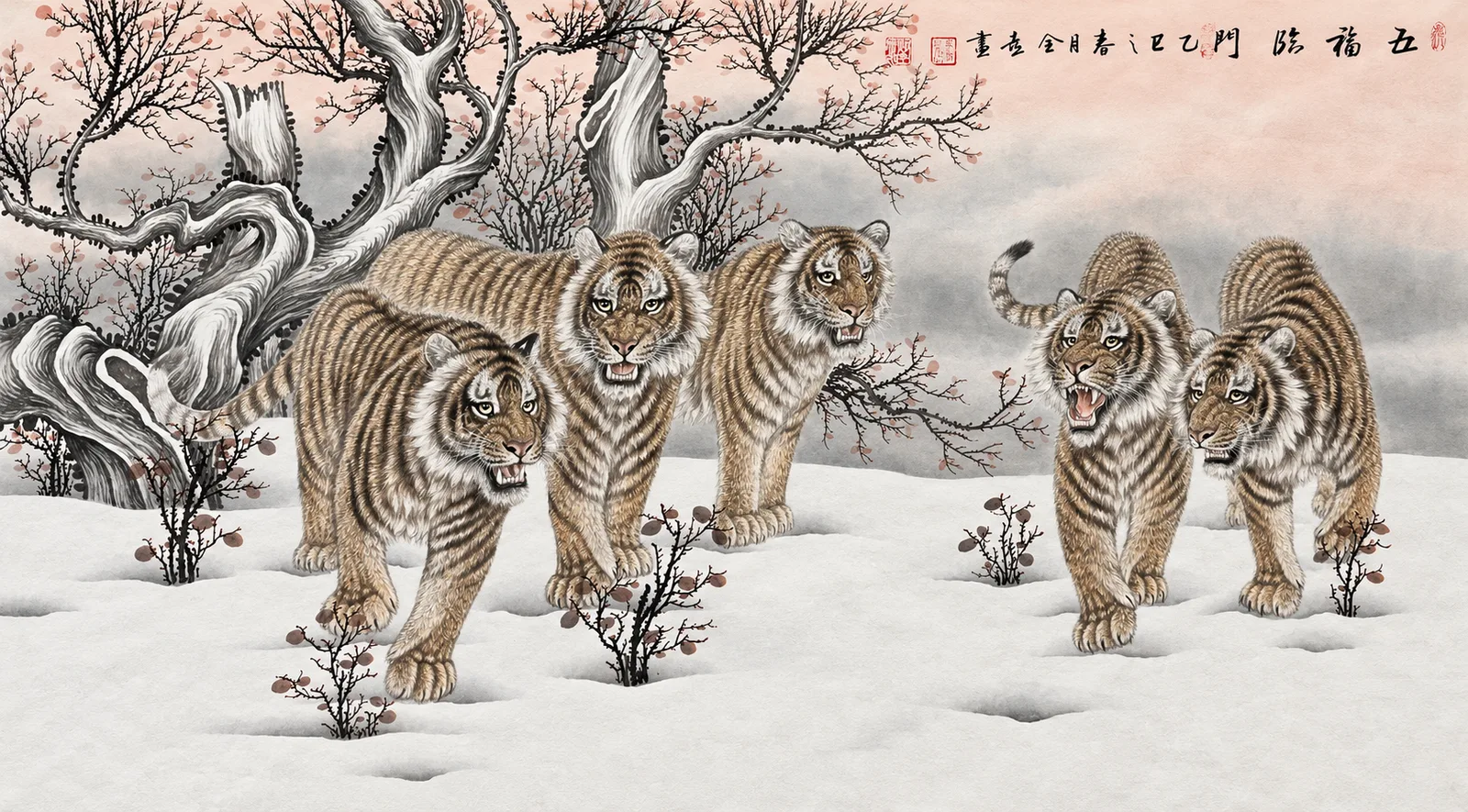
A household of tigers
A painting of five tigers is one of the most familiar group compositions in Chinese tiger painting. The animals are shown together on a shared piece of ground: often two adults with three younger tigers, or a group of adults and cubs arranged across rock and grass. They are not fighting. They are gathered, walking, resting, turning toward one another, and that gathering is what the painting is about.
Reading the composition
The five-tiger painting typically sets the group in a landscape of rock ledges, pine, and often a stream or a patch of bamboo. The animals occupy different levels of the scene, so the eye moves through the group from one tiger to the next, the way it would move through a family photographed at different ages. In traditional compositions there is usually one dominant tiger, often facing front or slightly turned, with the others distributed around it. The arrangement is deliberately domestic rather than dramatic.
Technique: five coats of fur
The work is done in gongbi, the fine-brush mode. Each tiger receives its own ink outline and its own sequence of thin washes in ink and mineral pigment, with the fur drawn stroke by stroke along the body. A group painting multiplies the labour, since five animals mean five complete sequences of outlining and fur work, and it also makes new demands on consistency: the coats must be finished to the same density even though they are completed at different times. The result, at its best, is a single scene whose five bodies look like members of one family rather than five separate paintings placed side by side.
The five blessings in Chinese culture
Five is a significant number in Chinese culture, and the expression the five blessings is an old and widely known one. The blessings are traditionally listed as: a long life; wealth; health and peace; virtue, or the love of virtue; and a peaceful end. The list has been repeated in Chinese writing and decorative art for centuries, and it stands behind many five-part images, from five bats to five cranes. A painting of five tigers belongs to that pattern.
It should be said plainly that this is a traditional framework of meaning and belief, not a set of promises. A five-tiger painting is associated with the five blessings in the same way any traditional motif is associated with its theme: by convention and long use, not by any mechanism. A buyer who values the painting for its craft alone is as well served by it as one who values the traditional reading.
Why a group of tigers reads as a family
The tiger in Chinese art is usually a solitary animal, powerful, watchful, alone on a mountain. When several tigers appear together, especially with smaller animals among them, the image shifts register. The group is read as a household: elders and young, protection and continuity. In a domestic setting the five-tiger painting is therefore about the family that lives with it, the generations present in one house, and the wish that the household hold together. The five blessings reinforce the point, since long life, health, and a peaceful end are blessings a family shares rather than an individual holds.
Where a family group painting traditionally goes
The traditional placement for a painting about a household is the room where the household gathers. In practice this most often means the living room, on the main wall, in a position that faces the primary approach to the space, the wall one sees on entering or the wall opposite the main seating. The idea is that the group of tigers is met head-on, as a family is met when arriving home. A secondary position is the wall behind the main seating, where the painting sits with the household rather than confronting visitors.
Do:
- Hang it in the living room or the main room of the house, the space where the family actually collects.
- Place it on the principal wall, in a position that faces the main approach into the room.
- Give it enough space to be seen as one complete group, since the composition depends on all five animals being visible at once.
- Keep it at eye level and out of direct sunlight, and store it dry when it comes down.
Do not:
- Do not hang it in a bedroom, a bathroom, or another private or damp room.
- Do not split the painting up visually by crowding it with unrelated works on the same wall.
- Do not hang it at a distance too small for the composition to be read, or in a passage where viewers must pass too close to take it in.
What buyers receive
The five-tiger painting is made to order on Xuan paper using ink and mineral pigments. It is available in several sizes, from a medium scroll for a sitting room to large panels for a main wall. Mounting is chosen to suit the room: a hanging scroll in the traditional manner, or a hand scroll for those who prefer the painting kept rolled and viewed on a table. Every order ships with a numbered certificate of authenticity, and the brand name is written TigerVow · Quanxi. This painting is described at the five tigers page, and the full gallery is at the gallery.
0 Comments
No comments yet. Start the conversation!