Hundred Tigers Painting: Meaning, Symbolism and Where to Hang It
TigerVow Studio Official
· 1 views
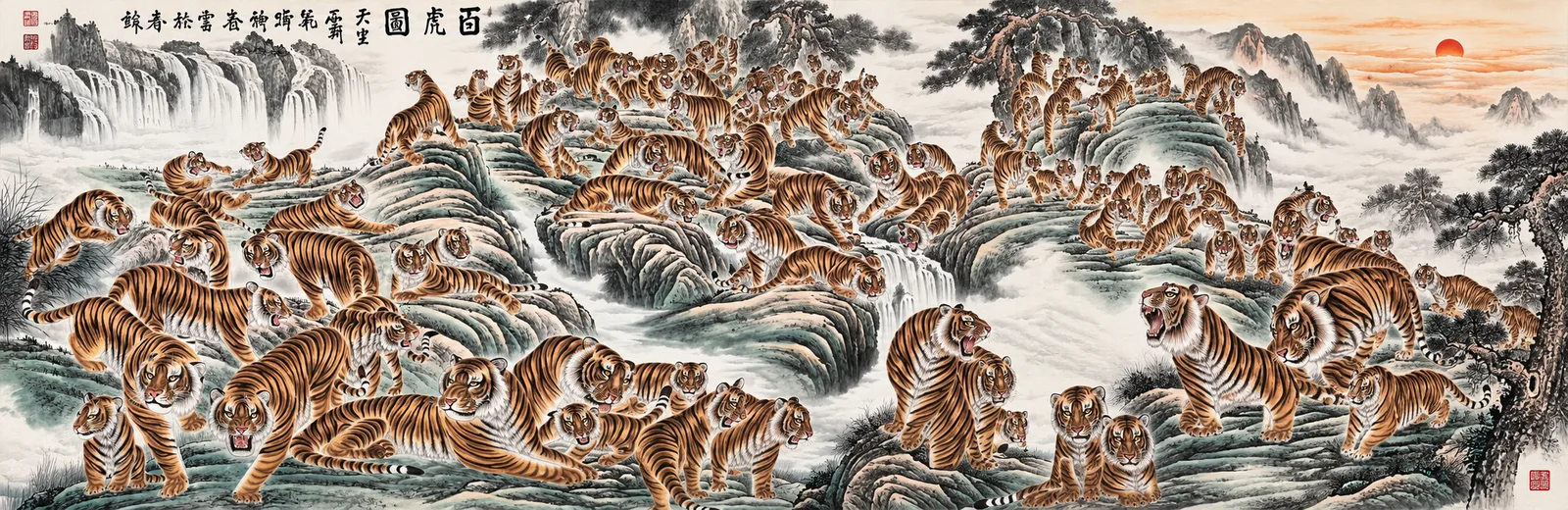
A scroll long enough to hold a hundred tigers
Among the traditional formats of Chinese painting, the hand scroll is the one built for length. A hanging scroll presents a single picture on a wall; a hand scroll is a horizontal ribbon of paper, sometimes several metres long, unrolled a section at a time on a table. The hundred-tiger scroll, crowded with the animal at every scale from crouching cubs to full-grown adults, is a subject that belongs to this format.
What a hundred-tiger scroll depicts
Despite the name, the count is a way of speaking. A hundred-tiger painting shows tigers in many poses: walking, resting, climbing, drinking, turning to look back. Adults and cubs share the ground, and the composition is usually organised along a landscape that unfolds with the scroll, with rocks, pines, water and cloud passing in sequence. The animals belong to one continuous territory rather than to a single stage.
Technique: gongbi at length
The painting demands the discipline of gongbi, the fine-brush method, at unusual length. Every tiger is outlined in ink and then built up in thin washes of ink and mineral pigment, with the fur drawn stroke by stroke along the body. On a scroll with many animals the labour multiplies with each additional figure, and the painter must keep the whole roll consistent, so that a tiger near the end has the same density of coat as one near the beginning. Work of this kind is measured in months.
Why many tigers? The meaning of multiplicity
In Chinese art, repetition is rarely only repetition. A crowded composition traditionally suggests abundance, the idea that a good thing multiplied is a blessing multiplied. A scroll of many tigers is understood in that way: one tiger is a powerful image, and a hundred tigers is an image of power in plenty, extended rather than concentrated.
Tigers themselves have a settled place in Chinese thinking. They are associated with protection, with the guarding of a household, and with strength held in reserve. A hundred-tiger scroll joins that association to the older convention that a multitude of a good thing is itself auspicious. These are traditional beliefs about what an image is associated with, not claims about what a painting will do for a room.
How the scroll is unrolled and viewed
A hand scroll is not viewed all at once, and it is not made to be hung. It is placed on a table and opened from the right end, one arm's length at a time, while the part already seen is rolled up again at the left. The viewer moves through it as one moves through a text: this section, then the next. The experience is deliberately sequential. A tiger that stands alone in the first passage may be joined by others further on, and the strip of landscape connects them. Viewing the whole scroll therefore takes time, and that pacing is part of the composition.
Where and how people traditionally use it
At the table
Because it is a hand scroll, the hundred-tiger painting is traditionally kept rolled and brought out for viewing rather than hung permanently. Households that own one treat it as an object with a small ritual of its own: opened after a meal or on an occasion, examined section by section, discussed, and rolled away. Where a hanging scroll is part of the architecture of a room, a hand scroll is part of the furniture of an occasion.
On a wall
Some owners have a long hand scroll mounted so that it can also be displayed on a wall, where the layout allows a run of several metres. Placement then follows the customs for tiger paintings generally: a principal wall, seen from the main seating, out of direct light.
Do:
- Open and close it on a clean, flat surface, using the rollers at each end rather than pulling the paper.
- Handle it with clean, dry hands, touching the mounting borders rather than the painted surface.
- Store it rolled, in a dry and dark place, away from damp and daylight.
- Give it air from time to time with a careful unrolling, which helps keep paper and mount in condition.
Do not:
- Do not display it in sunlight, since ink and mineral pigments fade.
- Do not leave it unrolled for long periods, as the paper takes a set and the mount slackens.
- Do not store it in a damp room or a sealed plastic tube, where moisture is trapped against the paper.
Sizes, mounting and the certificate
The hundred-tiger scroll is painted to order on Xuan paper using ink and mineral pigments. It is mounted as a hand scroll in the traditional manner, with a hanging-scroll option where the composition suits a wall. Sizes run from shorter rolls intended for viewing at a table to extended scrolls made for a long wall. Every work ships with a numbered certificate of authenticity, and the brand name is written TigerVow · Quanxi. This painting is described at the hundred-tigers scroll page, and the full gallery is at the gallery.
0 Comments
No comments yet. Start the conversation!