TigerVow · Quanxi: three decades of painting tigers in China's tiger painting village
TigerVow Studio Official
· 1 views
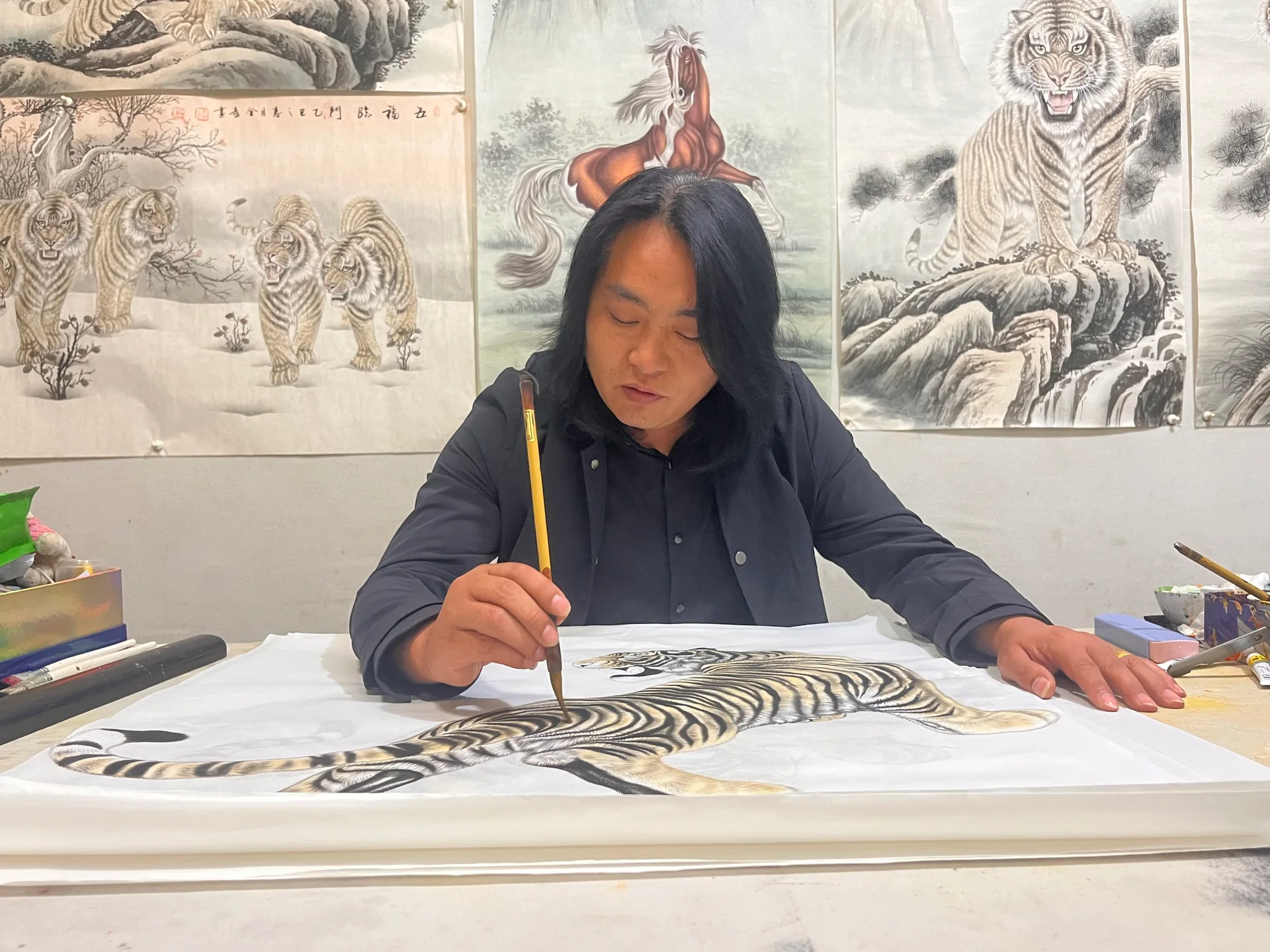
Who paints under the name TigerVow · Quanxi
TigerVow · Quanxi is the working name of a gongbi painter from Wanggongzhuang, a village in Henan province, China, that is known for tiger painting. Wanggongzhuang's reputation rests on a single subject practised across generations: the tiger, rendered in the fine-brush manner known as gongbi.
The painter was born in 1988 and trained under older masters of that village school. He works today as a first-class painter and is a member of the Henan painters' and calligraphers' associations. In 2010 he completed a very large tiger scroll, a work on a scale the gongbi method reaches only when a painter commits months of labour to a single sheet. The name he paints under is always written TigerVow · Quanxi, and it is the name that appears on the work sold from this studio.
The three decades of the title are a rough frame rather than an exact ledger. What is concrete is simple: a birth in 1988 in a village whose trade is tiger painting, training under older masters, and years of commissioned work. That sequence, village first and master second, is the ordinary shape of an apprenticeship in Chinese folk craft, and it is the context in which these paintings are best understood.
What gongbi tiger painting asks of a painter
Gongbi, the fine-brush mode, is the opposite of a loose, improvised manner of painting. Where a freehand approach suggests a tiger in a few decisive movements, a gongbi painter builds the animal slowly, in layers, from a precise outline. Nothing about the animal is left to chance, because nothing can be corrected later.
Line comes first
Every gongbi painting begins with an outline drawn in ink. For a tiger this means the anatomy is settled at the drawing stage: the set of the shoulders, the fall of the tail, the placement of each stripe. In the Wanggongzhuang school the stripes are not decoration; they follow the body, wrapping the ribs and thickening along the spine.
Colour is laid in thin layers
Colour then arrives in many thin washes rather than in one heavy passage. The paintings are made with ink and mineral pigments, materials ground from stone and earth and valued for the steadiness of their colour. A fur coat is built from repeated applications, each allowed to dry before the next, until the desired depth appears.
Why a village tradition matters
Technique of this kind travels by hand rather than by book. Older painters correct a younger painter's line, demonstrate a fur stroke, and pass down the shared conventions of the school, from the proportions of a tiger's head to the preparation of pigment. A village that concentrates on one animal accumulates unusually specific knowledge about it, and Wanggongzhuang's reputation is the result of that concentration over generations.
The life of a painting, from paper to mounted scroll
Paper
Work begins on Xuan paper, the traditional Chinese paper made for ink and brush. Its surface takes ink cleanly and tolerates the repeated washes gongbi requires, without tearing or buckling as the layers accumulate.
Outline
The drawing is transferred to the paper and completed in ink. This stage decides everything that follows, since a line placed badly cannot be repainted, only worked around.
Fur layers
The fur is the long labour. Short strokes are laid in sequence across the body, following the direction of growth, and every pass adds density rather than replacing what came before. Ink and pigment alternate so that the coat keeps its depth instead of flattening into a single tone.
Seals
When the painting is finished, the painter's seals are stamped in red ink. A seal is the traditional mark of authorship and completion, and on these works it accompanies the brand name TigerVow · Quanxi.
Mounting
The finished sheet is mounted as a scroll in one of two traditional formats: the hanging scroll, displayed vertically on a wall and rolled for storage, or the hand scroll, viewed horizontally and unrolled a section at a time. Mounting is a craft of its own, and the silk and paper borders are part of how the painting is meant to be seen.
A working day in the studio
A gongbi studio runs on sequence rather than mood. A day usually begins with preparation: pigments mixed fresh, brushes checked, the panel already in progress reviewed. Mineral colours are prepared as they are needed, and the previous day's layers must be fully dry before more can be added. The central hours go to fur strokes and washes in short, patient sessions, because the eye tires and the hand follows. Since paintings are made to order, the day also includes time for correspondence with buyers, confirming subject, size, and mounting before the work is begun.
Where a tiger painting is traditionally placed
Placement customs record what an image has been associated with in the tradition; they are not guarantees of any outcome. The notes below follow common practice.
Do:
- Hang the scroll where it can be seen from a seated position, since a room is usually arranged around the view of a wall.
- Give the painting a wall of its own, or at least generous space, so that the mount and the seals remain visible.
- Keep it away from direct sunlight, which fades ink and mineral colour over time.
- Store it rolled in a dry place when it is not on display, and handle the paper by its mounting borders.
Do not:
- Do not hang it in a damp room such as a bathroom, where moisture damages both paper and mount.
- Do not place it directly above a heat source or an air vent.
- Do not crowd it with unrelated framed works on the same wall, so that it reads as part of a block rather than as a single painting.
What buyers receive
Paintings are made to order on Xuan paper with ink and mineral pigments, in sizes from a modest scroll for a study to large pieces for a main room. Available subjects include the hundred-tiger hand scroll and single-animal compositions such as two tigers on the misty cliff. Each work is mounted as a hanging scroll or a hand scroll, according to the buyer's choice and the shape of the composition. Every order ships with a numbered certificate of authenticity, and the brand name is written TigerVow · Quanxi. The full gallery is at the gallery.
0 Comments
No comments yet. Start the conversation!