Heroic Bearing: The Ascending Tiger and the Feng Shui of Steady Rise
TigerVow Studio Official
· 3 views
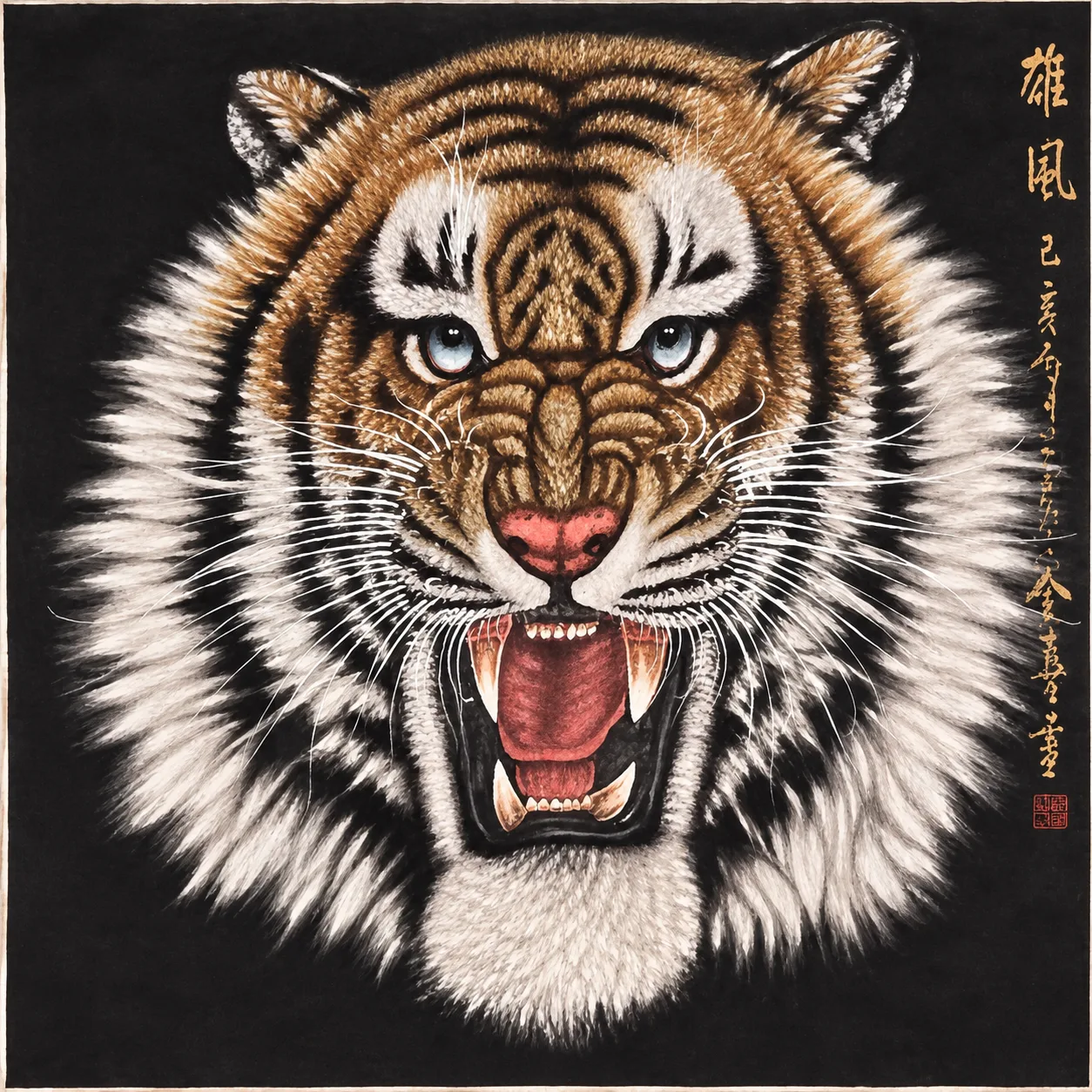
Heroic Bearing is the quietest kind of tiger painting. There is no snarl, no leap, no open mouth. The animal is climbing, its body angled upward, its expression composed. In the old houses this was the form hung for steady rise — the tiger that does not announce its ambition but keeps moving up the mountain. The Chinese phrase often attached to it is bù bù gāo shēng, a step higher at every step. For a study, an office or a stairwell, it is one of the most useful images in the tradition.
The ascending tiger explained
Chinese tiger painting distinguishes between the ascending tiger (shàng shān hǔ) and the descending tiger (xià shān hǔ). The ascending form is shown climbing, usually with its head lifted and its body moving up a slope. It is associated with progress, promotion, examination success and the accumulation of wealth over time. The descending tiger, by contrast, is associated with coming down from the mountain to hunt — a more aggressive, protective image, often used for guarding an entrance.
The distinction is not merely a pose. It changes the energy of a room. An ascending tiger supports effort and forward movement; a descending tiger confronts what is outside. Placing the wrong one in a study can make the room feel defensive rather than ambitious. Heroic Bearing is firmly in the ascending tradition: the body rises, the gaze is level rather than glaring, and the mood is dignified rather than predatory.
What the painting shows
The tiger's coat is laid in fine gongbi strokes, and the leaves around it are washed deep green. That green is important. It cools the gold of the animal and makes the fur the only warm note in the picture, so the eye goes straight to the tiger. The composition is relatively open; there is no dense undergrowth or dramatic weather. The animal is given space to climb.
The face is the center of gravity. The eyes are calm, the muzzle is closed, and the head is turned slightly toward the viewer without a direct challenge. This is the expression the old painters called wēi — dignity or bearing — rather than nù, anger. It is the look of someone who has already done the work and does not need to prove it.
Feng shui: placing the ascending tiger
The study
The classic placement is a study or home office. Hang the painting on the wall behind the desk, or on the wall the desk faces, so that the tiger's upward movement is visible while you work. The rising line should point into the room, not out of a window or door. In practice this means the tiger's head and body should angle toward the center of the room rather than toward an exit.
The office
In a professional office, place it behind the desk or on the wall to the side of the desk, at eye level. It is a good image for anyone whose work depends on steady advancement: lawyers, academics, managers, salespeople, founders. Avoid placing it behind the chair of a visitor, where it can feel like pressure rather than support.
The stairwell
A stairwell is a natural home for an ascending tiger. Hang it so that the animal appears to climb with the stairs. This is one of the few places where the direction of the painting and the direction of the architecture can work together. Do not hang it so that the tiger appears to be descending toward the front door.
Where not to hang it
- Not in a bedroom. The image is active and career-oriented; it belongs in a room associated with work or movement.
- Not facing a descending tiger in the same sightline. The two forms pull in opposite directions.
- Not in a bathroom, kitchen or damp basement.
- Not so high that the upward movement is lost above the viewer's eyeline.
The craft: green, gold and restraint
The painting's restraint is technical as well as emotional. The leaves are washed in deep green, built up in layers so that the foliage has depth without becoming a flat backdrop. The tiger is painted with a fine outline, then layered washes of ochre and pale gold, then individual fur strokes. Because the background is green rather than black, the artist cannot rely on strong contrast; the edge of the animal has to be defined by the fur itself.
The face is painted late in the process, after the body and the foliage are resolved. The eyes are kept narrow and level, and the mouth is closed. In gongbi painting, a closed mouth is harder to make interesting than an open one, because the expression has to come from the eyes and the set of the head. The result is a portrait that rewards close looking rather than immediate impact.
The green leaves are painted with a combination of outline and wash. The veins are drawn first, then the color is floated in, then darker accents are added where the leaves overlap. The final seal and inscription are placed to balance the composition without crowding the tiger's upward line.
Collection value: the career painting
Ascending tigers have a specific collector base. They are bought for studies, offices and professional spaces, and they are often commissioned at moments of transition: a promotion, a new practice, a retirement from one career into another. That gives the image a personal history that a generic roaring tiger does not have.
Heroic Bearing is offered at Standard and Premium levels in 54 × 27 inches and 66 × 38 inches, unframed, made to order on Xuan paper. The larger format suits an office or a stairwell; the smaller format is well proportioned for a study or a home desk. Each work ships with a certificate of authenticity and is documented with progress photographs from the outline stage to the finished seal.
For collectors, the appeal is the combination of a classic subject with a restrained palette. The deep green and gold are easier to live with than a high-contrast black-and-orange tiger, and the closed mouth makes the painting suitable for rooms where a roar would be too much. Keep the certificate and the progress emails; frame with acid-free materials and UV-filtering glazing; keep the work out of direct sun.
Living with an ascending tiger
The painting rewards a wall that is relatively uncluttered. Give it space above and to the side so that the upward movement is not blocked by a shelf or a cabinet. A picture light from above will bring out the green washes; avoid a direct spotlight that flattens the gold. In a room with warm wood, the green reads as a cool counterpoint; in a white room, it becomes the main color note.
If you want a companion, choose a quiet landscape or a calligraphy piece rather than a second tiger. The ascending tiger is a statement about direction; too many directions in one room becomes noise.
Questions collectors ask
What is the difference between an ascending and a descending tiger?
An ascending tiger is shown climbing, and is associated with progress, promotion and steady wealth. A descending tiger is shown coming down from the mountain, and is associated with protection and confronting threats. The ascending form is generally preferred for studies and offices; the descending form for entrances.
Can I hang it in my bedroom?
It is not the best choice. The image is active and career-oriented. A study, office, living room or stairwell is more appropriate.
Does the tiger need to face the door?
Not in the same way as a guardian tiger. For an ascending tiger, the important thing is that the rising line points into the room and that the painting is visible from the desk. Facing the door is optional; facing the worker is more useful.
See the full painting and size options on the Heroic Bearing product page. To compare the two forms, read Ascending vs descending tiger.

0 Comments
No comments yet. Start the conversation!