Tigers in the Snowy Woods: Companionship, Endurance and Winter Feng Shui
TigerVow Studio Official
· 3 views
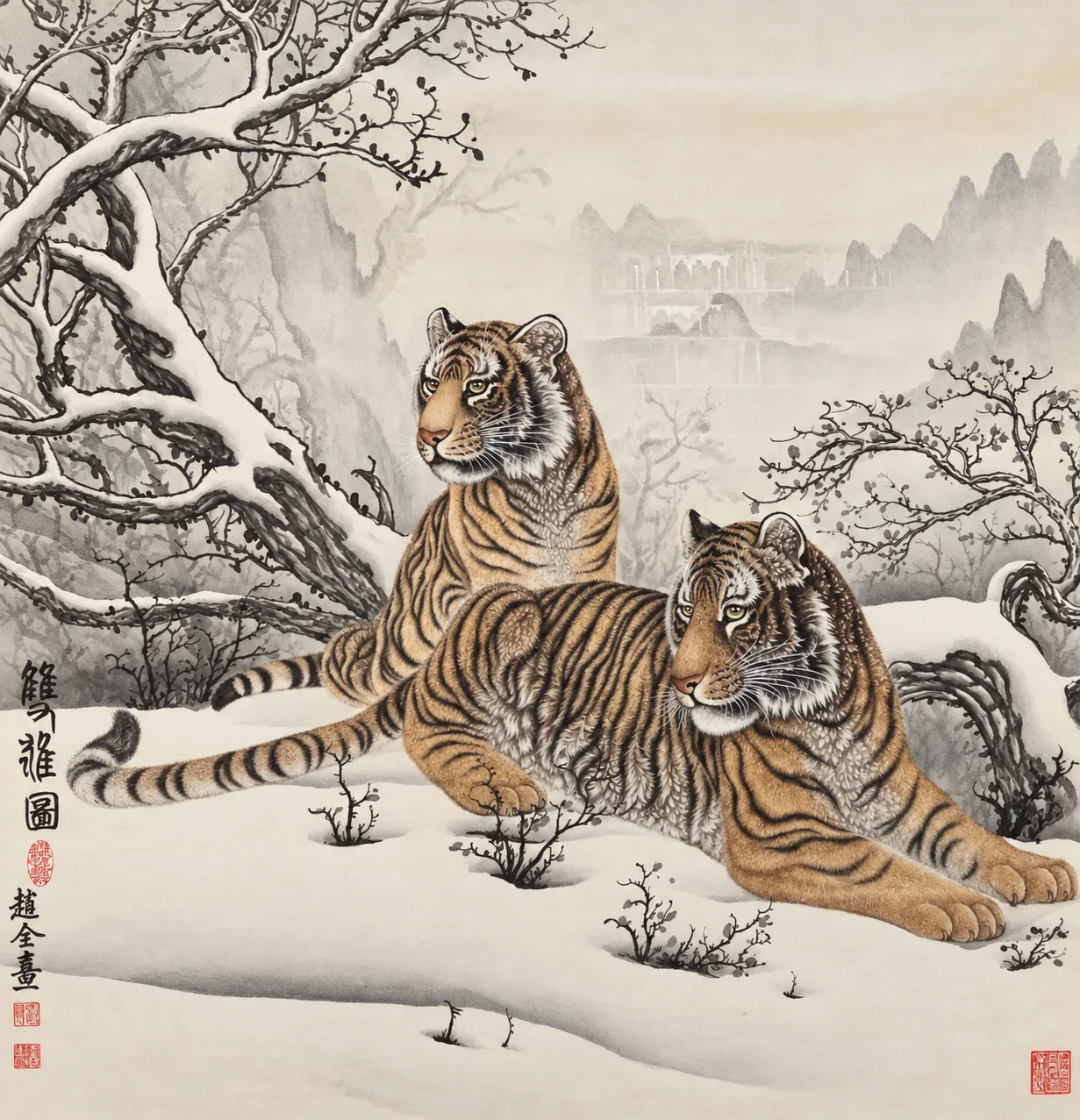
The old saying is that the tiger roars through the mountain forest. Tigers in the Snowy Woods holds the roar back. Two tigers share a snowfield in a landscape of soft grey washes; one sits upright and watchful, the other is lower and at ease. There is no open mouth, no charging stride, no dramatic rock. The strength in the picture is the strength of something that does not need to prove itself. In a collectors' market full of roaring tigers, that restraint is the painting's signature.
What the snow does to the image
Snow changes the grammar of a painting. It removes the usual cues of season and terrain and leaves the artist with tone, edge and negative space. In this composition, the snow is not painted as a white field with objects on top; it is created by leaving the paper largely untouched and building the landscape around it. The grey washes of the sky and the distant trees define the snow by contrast. The tigers' coats are warm against that cool ground, and their breath, movement and weight are suggested rather than described.
The two animals are placed so that one watches and one rests. The upright tiger's head is turned in profile, alert to something outside the frame; the second tiger is settled lower, its body relaxed. The pairing reads as companionship rather than confrontation. The soft grey washes around them keep the scene quiet, almost muffled, like the acoustic of a forest after snowfall.
The meaning of the winter tiger
In Chinese symbolism the tiger is a yang animal, associated with summer, fire and the western direction. Placing it in snow creates a deliberate tension: yang energy held inside a yin landscape. Traditional painters used this contrast for a reason. The winter tiger is not weaker for being in the cold; it is more impressive because it endures. The image speaks to resilience, patience and strength in reserve.
For a family, the pair adds a second layer: loyalty. Two tigers in a shared landscape are a household image, not a solitary guardian. The snow makes the companionship feel earned. This is a painting about keeping each other warm, in the plainest sense.
Feng shui placement for a snow scene
The living room
A snow scene belongs in a room where people gather and slow down. Hang it on a wall that receives soft, indirect light; the grey washes need gentle illumination to show their gradations. In a living room, place it where it can be seen from the main seating but not directly opposite a doorway at close range. The tigers should look into the room, not out into the hall.
The study or library
The quiet, watchful mood suits a study. A winter tiger is a good companion for long work: it suggests endurance without demanding attention. Hang it to the side of the desk or on the wall the desk faces, at eye level. The cool palette is also less distracting than a gold tiger in a small room.
The north or west wall
In compass-based feng shui, the north is associated with water and stillness, and the west with metal and the tiger. A snow scene is sympathetic to both. If the room has a strong south-facing window and too much heat and light, a north or west wall can restore balance. Avoid placing the painting in a dark, damp corner; the subject is winter, but the paper should not actually live in one.
Where to avoid
- Not in a bathroom or kitchen, where steam and grease damage the paper.
- Not directly over a radiator or fireplace, where dry heat causes the paper to cockle.
- Not in a dark hallway where the subtle greys will disappear.
- Not paired with a roaring tiger in the same sightline; the two moods cancel each other.
How negative space is painted
The snow scene is one of the most demanding subjects in gongbi painting because so much of the picture is unpainted. The artist begins with a light outline of the tigers and the tree trunks, then lays in the sky and the distant forest with diluted ink. The snow is the paper itself. Any stray mark in the reserved area is difficult to remove, so the drawing has to be planned from the first line.
The tigers' fur is painted in fine strokes, but the snow around them is protected with equal care. The artist works from the background forward: sky, distant trees, middle-ground washes, then the animals, then the foreground snow shadows. The shadows are not grey paint applied uniformly; they are thin washes that follow the contours of the ground, with the paper left bright where the light falls. The result is a snowfield that looks soft rather than flat.
The tigers themselves are painted in warm ochre and pale gold, with individual fur strokes following the direction of growth. Because the background is cool, the warm coat separates naturally. The eyes are kept calm; a wide-eyed tiger in this setting would break the mood. The final seal and inscription sit in a quiet corner, where they do not compete with the snow.
Collection value: the quiet tiger
Snow scenes are less common than gold-toned tiger portraits, and they appeal to a different collector: someone who wants a tiger painting that can live in a calm interior. The labor is in the control of wash and negative space rather than in dense color. A painter who can leave the paper alone is usually a painter with confidence.
The work is offered at Standard and Premium levels in 54 × 27 inches and 66 × 38 inches, unframed, made to order on Xuan paper. The larger format gives the snowfield room to breathe and is the better choice for a living room or a gallery wall. The smaller format suits a study, a bedroom or a narrow wall. Each painting ships with a certificate of authenticity and is documented with progress photographs from the outline stage onward.
When framing, choose a warm neutral mount rather than a cold white one; the contrast will make the snow look brighter. Use UV-filtering glazing and acid-free materials. Keep the painting away from direct sun and from sources of heat. The greys are subtle and will be the first thing to suffer if the paper is exposed.
Living with a winter painting
A snow scene is not a seasonal decoration, but it does change with the year. In summer it cools a room; in winter it feels like a window onto the same season. That makes it a good choice for a room that is used year-round and a poor choice for a room that is already cold, dark and unused. The painting needs light and human presence to come alive.
If you are building a pair, choose the autumn grove or a quiet landscape. The snow scene is a complete mood; it does not need another tiger to explain it.
Questions collectors ask
Is a snow tiger unlucky?
No. The tiger remains a protective and auspicious animal; the snow adds the qualities of endurance and stillness. In feng shui the image is read as a whole, and a calm pair in a landscape is generally considered harmonious.
Can it hang in a bedroom?
Yes, more easily than a roaring portrait. The mood is quiet and the palette is cool. Keep it off the wall directly opposite the bed if you prefer not to be watched, and avoid a dark corner.
Why are the tigers not roaring?
The painting is about strength in reserve. The absence of a roar is deliberate; it makes the image suitable for rooms where a more aggressive tiger would be too much.
See the full painting and size options on the Tigers in the Snowy Woods product page. For the autumn counterpart, see Two Tigers in the Autumn Grove.

0 Comments
No comments yet. Start the conversation!