Two Tigers in the Autumn Grove: Love, Loyalty and Feng Shui for the Family Home
TigerVow Studio Official
· 3 views
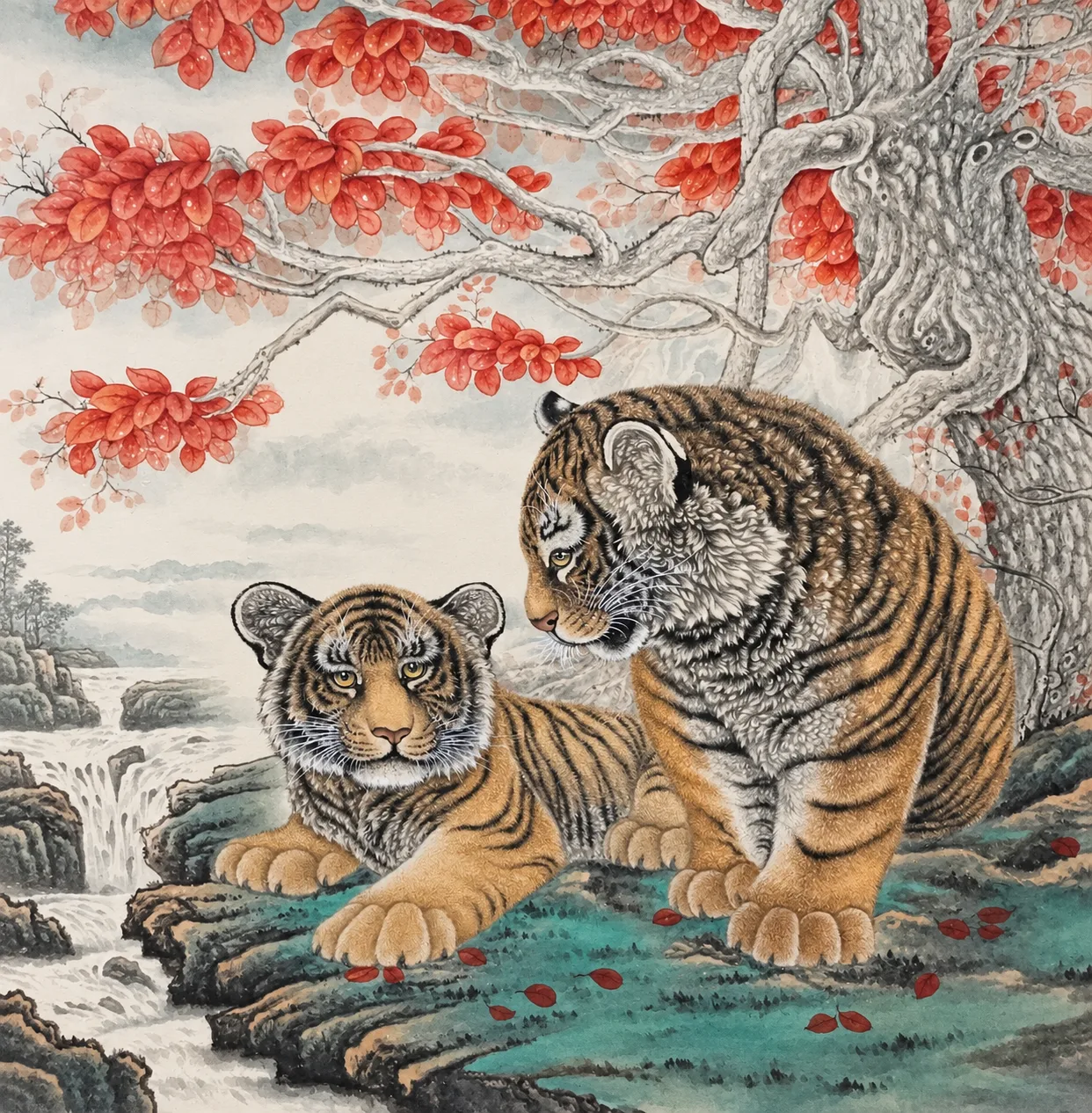
Some tiger paintings are about power. Two Tigers in the Autumn Grove is about company. The scene is built around an old tree trunk on the right, its crown of red leaves burning across the top of the frame, with a waterfall and a quiet river on the left. Teal-green moss covers the ground, scattered with fallen red leaves. The two tigers are painted in pale gold, and their stripes are soft rather than graphic. Nothing in the picture is in a hurry. That is precisely the point.
The composition, element by element
The painting is a landscape as much as an animal portrait, and the landscape carries most of the emotional weight. The old trunk on the right is the anchor: gnarled, textured, painted with dry-brush strokes that catch the roughness of bark. Above it, the red canopy is built from clustered leaves rather than a flat mass, so the color has movement. On the left, the waterfall drops into a river that leads the eye back into the middle distance. The teal moss and the fallen leaves tie the foreground together.
The tigers sit within this world rather than in front of it. Their pale gold coats are close in value to the moss and the autumn light, which is why the stripes read softly. One tiger is more upright and watchful; the other is lower and more relaxed. The pair is not symmetrical. That asymmetry is what makes them feel like a family rather than a logo.
What a pair of tigers means
In Chinese art, a pair of tigers is rarely just two of the same animal. The composition usually implies a relationship: a pair of adults, a mother and cub, or two siblings. The shared meaning is loyalty, protection and continuity. Where a single tiger says I am here, a pair says we are here.
That makes the image especially appropriate for a family home. It is also a common gift for a wedding or an anniversary, because the two animals are oriented toward a shared space rather than toward the viewer. The tigers are not performing for us; they are keeping each other company. In a living room or dining room, that quiet companionship becomes part of the atmosphere.
Feng shui: the balance of the autumn grove
Autumn is the season of metal in the Chinese five-element cycle, and the painting deliberately balances that cool, contracting energy with warmth and movement. The red leaves bring fire; the tree and moss bring wood and earth; the waterfall and river bring water. The result is a unusually complete elemental picture — which is one reason it works in rooms that already have a strong single-element character.
The living room
This is the most natural home for the painting. Hang it on a wall that the family faces when seated together, or on the wall behind the main sofa if the ceiling allows. The pair should look into the room rather than out of a window. In feng shui terms, the image gathers the family's attention toward a shared center.
The dining room
Autumn is the harvest season, and a pair of tigers in a fruitful grove is a sympathetic image for a dining room. Avoid hanging it directly over the table if the frame is heavy; a side wall or the wall behind the head of the table is better. The red canopy adds warmth without the aggression of a frontal roar.
The bedroom
Unlike a solitary roaring tiger, this painting is calm enough for a bedroom, particularly a couple's bedroom. The pair symbolizes partnership, and the landscape softens the tiger's yang energy. Keep it off the wall directly opposite the bed if you are sensitive to being watched; a side wall or the wall behind the headboard is gentler.
Direction and pairing
If you follow a formal bagua or compass school, the southwest is traditionally associated with marriage and partnership, and the east with family. Either can be appropriate. The painting also pairs well with a landscape or a hand scroll; it does not need another tiger in the same room.
The craft: painting autumn without clutter
An autumn grove is a test of restraint. It would be easy to fill the picture with leaves, but the composition keeps large areas of moss and water quiet so that the red canopy and the tigers stand out. The leaves are painted in small clusters, each with a slightly different orientation, so the canopy looks observed rather than patterned. The waterfall is rendered with vertical strokes of diluted ink and white, leaving the paper to suggest the spray.
The tigers are painted in the gongbi method: a fine outline first, then layered washes of pale gold and ochre, then individual fur strokes. Because the coat is close in tone to the background, the artist cannot rely on contrast to create the silhouette. The edge of each animal has to be defined by the direction and density of the fur, which is slower and more delicate than painting a dark tiger against a pale ground.
The moss is built from layered washes of teal and green, with darker accents where the ground dips. The fallen leaves are added last, after the moss is dry, so that they sit on the surface rather than dissolve into it. The overall effect is soft, but the sequence is strict: outline, wash, fur, foliage, accents, seal.
Collection value: the landscape premium
Among tiger paintings, landscape settings carry a premium in labor. A portrait with an empty background concentrates the work in the animal; a painting like this one asks the artist to build a complete world around it. The red canopy alone is hundreds of small marks. The waterfall, the river, the moss and the fallen leaves each require a different brush technique.
The painting is offered at Standard and Premium levels in 54 × 27 inches and 66 × 38 inches, unframed, made to order on Xuan paper. The larger format gives the grove room to breathe and is the better choice for a living or dining room. The smaller format works well in a bedroom or a narrow wall, where the viewer is closer to the detail.
For collectors, the appeal is the combination of subject and setting: a pair of tigers, a complete seasonal landscape and a documented commission from Minquan. Keep the certificate, the progress photographs and the original packaging. Frame with acid-free materials and UV-filtering glazing, and keep the painting out of direct sun; the reds and teals are the first colors to show fading.
Living with the painting
The picture changes with the season. In autumn it feels like a mirror; in winter it brings warmth; in spring and summer it reads as a memory of the year's turn. That is a useful quality in a room that is used every day, because the painting does not exhaust its welcome. Hang it where you sit for long periods rather than in a passage you only cross.
If you want a companion piece, choose a snow scene or a quiet landscape rather than a second pair of tigers. The grove is a complete world; it does not need competition.
Questions collectors ask
Is this painting suitable for a wedding gift?
Yes. A pair of tigers in a shared landscape is a traditional image of loyalty and continuity. It is a common gift for weddings and anniversaries, particularly when the couple enjoys Chinese art or has an interest in feng shui.
Can it hang in a bedroom?
It is calmer than a roaring portrait and can work in a couple's bedroom. Avoid direct eye contact with the bed, and choose a side wall if possible.
Will the red leaves fade?
All pigments can fade in direct sunlight. Use UV-filtering glazing and keep the painting away from a south-facing window. The reds and teals should be checked periodically; if they begin to look chalky, move the work to a less exposed wall.
See the full composition and size options on the Two Tigers in the Autumn Grove product page. For a winter counterpart, see Tigers in the Snowy Woods.

0 Comments
No comments yet. Start the conversation!