Royal Valor: The Pale Tiger, the Open Roar and the Feng Shui of Presence
TigerVow Studio Official
· 4 views
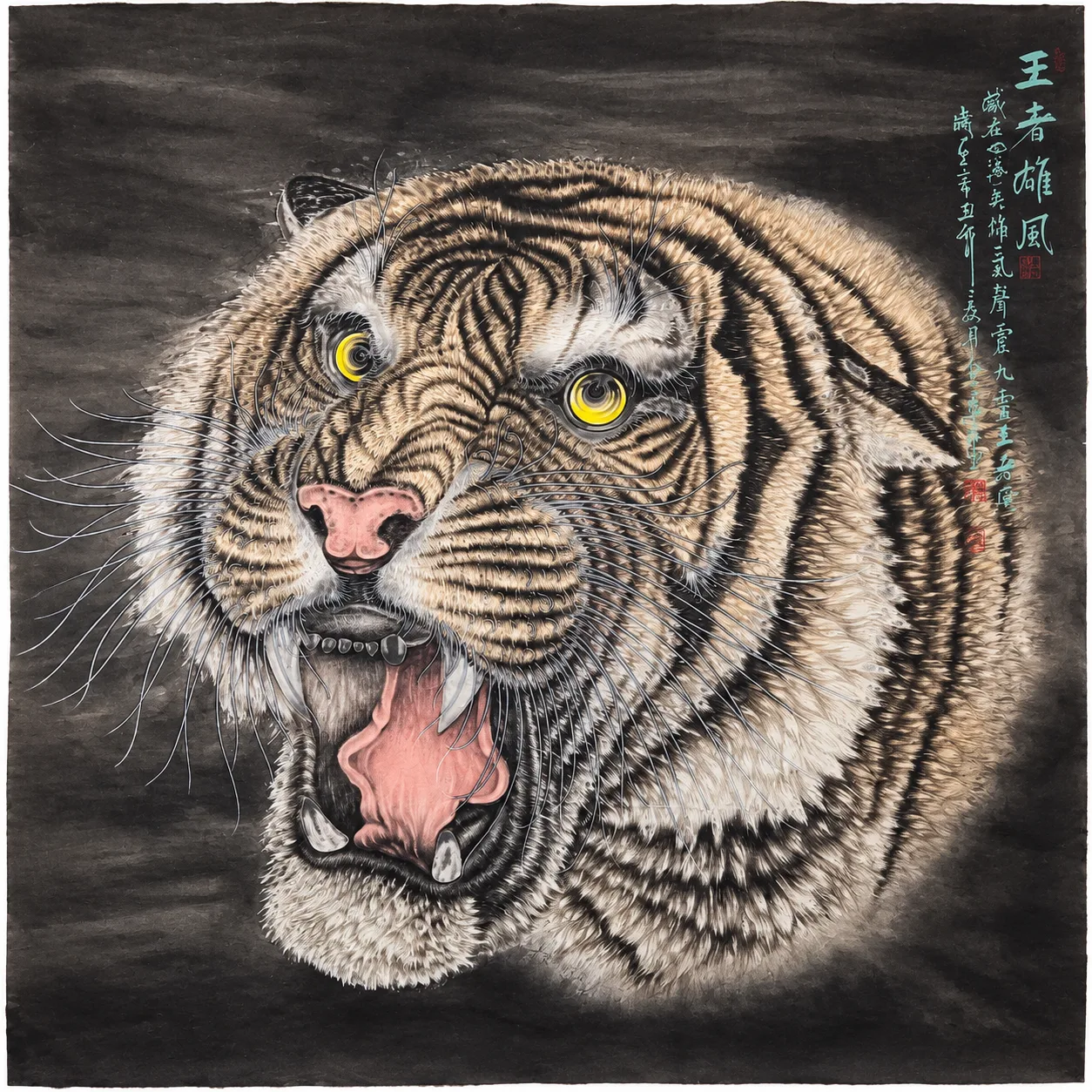
Almost every tiger painting in the market reaches for gold. Royal Valor does the opposite. Its coat is built from cream, bone and grey-white strokes, and the ground behind the animal is a soft black ink wash rather than a flat void. The effect is cool, almost silvery: the tiger seems lit from inside the paper rather than from the room. Then the mouth opens, and the picture changes register completely. This is a portrait of presence — the kind of authority that does not need to raise its voice, until it does.
Reading the composition
The tiger is frontal, held at the moment of a full roar. The mouth is the loudest shape in the picture, and the artist has used color with great economy: the coat is almost monochrome, the ground is black, and the only warm note is the red of the tongue. That single red accent is what keeps the image from becoming a study in grey. It catches the eye, then sends it back to the eyes and the teeth.
The black background is not simply empty space. It is a wash, with subtle variations in density that suggest atmosphere rather than a wall. Against it, the pale fur reads as volume. The whiskers and the fine hairs around the muzzle are painted over the dark ground, which is technically demanding: a single misplaced stroke cannot be hidden. The stripes are softer than in a gold-toned tiger, more like shadows in the coat than graphic marks.
What the roar means
In Chinese culture the tiger is the king of the beasts and the guardian of the western direction. Its roar is associated with authority, the power to command attention, and the dispersal of stale or threatening energy. A frontal roaring tiger is the most overt of the tiger forms. It is not a quiet companion piece; it is a declaration.
That makes Royal Valor a natural choice for an entrance, a reception room or a principal living-room wall. It is also why the painting should not be scattered through a house. One roaring tiger in the right place has authority. Three roaring tigers turn a home into a lobby.
Feng shui placement for a frontal tiger
The entrance and the guardian position
The classic placement is the wall that faces the front door, with the tiger looking toward the entrance. In traditional practice the tiger is a guardian of the threshold: its gaze meets whatever enters before the household does. Hang it at eye level or slightly above, not so high that the animal seems to be looking over the visitor's head.
The living room
In a living room, place the painting on a solid wall where it can be seen from the main seating but is not directly opposite a sofa at close range. A roaring tiger at two metres can feel aggressive; at four or five metres it reads as presence. If the room is small, choose the smaller size or move the painting to a hallway.
The home office
Behind or beside the desk, facing the door, is a strong position for a professional who negotiates, litigates or runs a business. The image supports the feeling of being backed by something formidable. Avoid placing it behind the visitor's chair, where it can feel like an ambush.
Where not to hang it
- Not directly facing a bed. The yang energy and the open mouth are too active for a room whose purpose is rest.
- Not in a bathroom or above a stove, where heat and moisture damage the paper and the symbolism is incoherent.
- Not facing another roaring tiger across a narrow space. Two open mouths in dialogue become noise.
- Not in a child's bedroom, where the image can be frightening rather than protective.
The white tiger question
Because the coat is pale, some buyers ask whether this is a baihu, the White Tiger of the western quadrant. The answer is that the painting is a color study rather than a depiction of the directional deity. The white tiger in Chinese cosmology is a specific guardian figure with its own iconography; this is a real tiger painted in a cool palette. The distinction matters if you are following a formal feng shui system. If you simply want the western metal element in a room, the pale coat and dark ground do carry that association, and a west wall is a sympathetic position.
The craft: why cool is harder than gold
Gold and orange are forgiving. They create instant warmth and depth, and the eye reads them as richness. A cream-and-grey tiger has nowhere to hide. The artist must build volume with very close values — the difference between the lit shoulder and the shadowed flank may be only a few steps of tone — and must keep the fur from turning muddy as the layers accumulate.
The process begins with a fine outline in pale ink. The ground is then washed in black, often in several passes, to create the soft gradient behind the animal. The coat is laid in thin layers of white, cream and grey, with each layer allowed to dry before the next. The fur strokes are painted individually, following the direction of growth and varying in length so that the coat does not look like a texture map. The tongue is painted near the end, when the rest of the mouth is resolved, because its red will immediately draw the eye and expose any weakness in the surrounding drawing.
Finally the eyes are set. In a frontal roar, the eyes carry the expression. If they are too wide, the animal looks frightened; too narrow, and it looks sleepy. The painter's task is to make them look focused on something just outside the frame.
Collecting a cool-toned tiger
Royal Valor is offered at Standard and Premium levels in 54 × 27 inches and 66 × 38 inches, unframed, painted to order on Xuan paper with ink and mineral pigments. The larger size is the more convincing format for a roaring portrait, because the head needs scale to dominate a wall. The smaller size works well in a hallway or a study, where the viewer is closer and the detail of the fur matters more than the overall silhouette.
From a collecting standpoint, the cool palette is a distinguishing feature. Most tiger paintings produced for the export market are warm and highly saturated; a restrained grey-white coat is less common and more dependent on drawing skill. The certificate of authenticity, the progress photographs and the original packaging should be kept with the work. As with any painting on paper, condition is part of value: avoid direct sunlight, damp walls and non-archival framing.
The painting is made in Minquan, Henan, by Quanxi, and the studio documents each commission from outline to seal. That documentation is not a marketing extra; it is the provenance of a made-to-order work, and it is worth preserving.
How to hang it well
Against a dark wall, the pale coat separates dramatically; against warm wood, it looks softer and more classical. Avoid a pure white wall directly beside a bright window, where the black ground can flatten into a silhouette. A picture light angled from above will bring out the wash; a direct spotlight will create glare on the glass and kill the subtlety.
Give the painting a wall of its own. A roaring tiger needs negative space around it, both visually and psychologically. If you want a pair, choose a quieter image — a turning tiger, a landscape or a hand scroll — rather than a second frontal roar.
Questions collectors ask
Is a roaring tiger suitable for a family home?
Yes, in the right room. The entrance, living room or home office are appropriate. Keep it out of bedrooms and small children's rooms, and avoid hanging it where guests sit with their backs to it at close range.
Does the pale coat mean it is a White Tiger?
No. It is a real tiger painted in a cool palette. The White Tiger is a separate cosmological figure. The painting can still be used to evoke the metal element of the west, but it is not a religious image.
Can I frame it myself?
Yes, but use a framer experienced with works on paper. Acid-free matting, archival backing and UV-filtering glazing are the minimum. Do not trim the paper or dry-mount it to a rigid board.
View the full painting and size options on the Royal Valor product page. For a calmer companion, see Tiger Raises the Wind.

0 Comments
No comments yet. Start the conversation!