Tiger Raises the Wind: Meaning, Feng Shui Placement and the Making of a Gongbi Tiger
TigerVow Studio Official
· 3 views
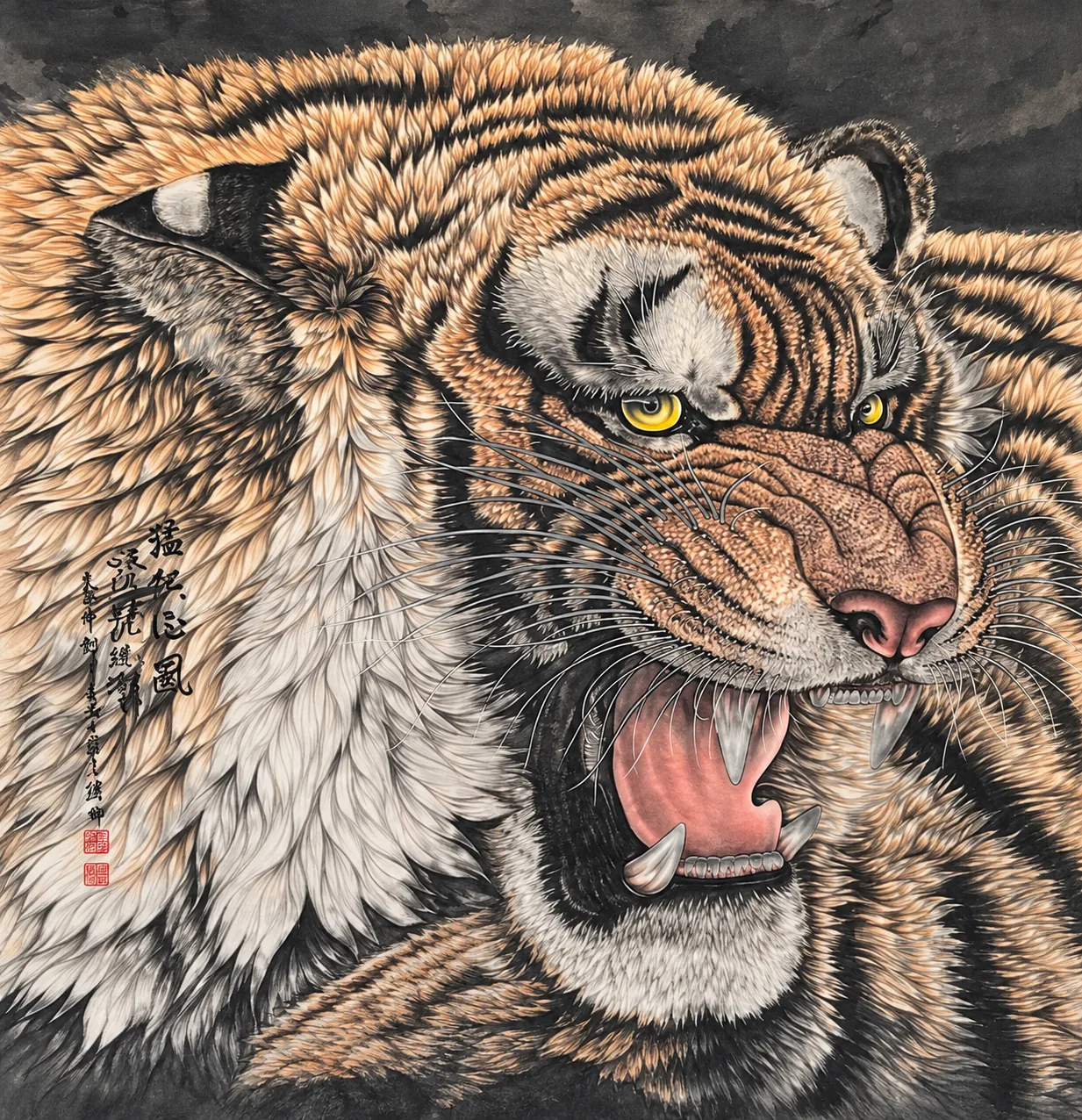
Most tiger paintings ask you to meet the animal face to face. Tiger Raises the Wind does something subtler. The tiger is already moving away from us, its body carried forward, and only the head has turned back over the shoulder. The result is not a portrait but a moment: the second before a roar, caught from behind. In Chinese painting this is the pose of hǔ xiào shēng fēng — a tiger's roar raising the wind — and it changes both how the picture feels and where it belongs in a house.
What the painting actually shows
The composition is deliberately bare. The ground is left as a dark, plain wash, with no rocks, grass or secondary animals to distract the eye. Against that quiet field, the pale ruff around the neck and the striped shoulder do all the work. The fur is built in fine, overlapping strokes; the stripes are not drawn as flat bands but laid into the coat so that the transition from cream to black reads as depth rather than pattern.
The turn of the head is the hinge of the whole picture. Because the body faces away, the viewer is placed slightly behind and to one side of the animal, as though walking into a room just as the tiger notices something. The eyes are level, the mouth is not fully open, and the expression stops short of aggression. This is alertness rather than attack — a distinction that matters in both collecting and feng shui.
The meaning of the backward glance
In the traditional vocabulary of Chinese tiger painting, a tiger looking back is often read as huí tóu hǔ, the returning tiger. The phrase carries several layers. At the simplest level it suggests vigilance: the animal is advanced but still watching its flank. In a household context it can be read as protection that does not need to face the threat directly. For collectors, the pose is also a display of technique, because the artist must render the front of the face and the back of the skull in one silhouette.
There is a practical reason the pose works so well on a wall. A fully frontal roaring tiger is a statement; a tiger caught mid-turn is a narrative. The second is easier to live with day after day, especially in a room where people read, work or talk. It remains powerful without dominating every glance.
Feng shui: where a turning tiger belongs
The traditional advice for tiger paintings is consistent: place the animal where its gaze can meet the approach to the room, not where it stares into a place of rest. Tiger Raises the Wind is particularly well suited to three locations.
The study or home office
Hang it on the wall to the side of the desk, or on the wall the desk faces, so the turned head looks toward the door rather than directly at the person working. The image supports concentration and a certain healthy wariness — the quality of noticing what is coming before it arrives. In feng shui terms this is a yang image, so it belongs in an active room rather than a bedroom.
The stairwell or hallway
A stairwell is a transition space, and a tiger in motion suits it. Place the painting so the animal appears to move upward with the stairs, not down toward the front door. This is one of the few places where a back-view tiger is actually preferable to a frontal one: the body leads the eye up the flight, while the turned head keeps the image connected to whoever is climbing.
The wall facing the entrance
If the painting is visible from the front door, position it so the tiger looks outward toward the door, not inward toward the bedrooms. This is the classic guardian arrangement. Avoid hanging it directly opposite a bed, and avoid placing it so that a seated guest is stared at from a very short distance. A tiger should feel like it is watching the room, not interrogating the furniture.
Pairing and direction
This painting was made as the natural partner to a head-on tiger portrait. If you own both, do not hang them face to face in a narrow corridor, where the two gazes can feel confrontational. Instead, place the frontal portrait in the main living space and the turning tiger in the study or stairwell. In the traditional left-right arrangement used in some feng shui schools, the dragon side is on the left as you face out from the house and the tiger side is on the right; if you follow that system, keep the tiger on the right and the dragon or landscape on the left.
Why the painting is difficult to make
The picture looks simple because the background is empty. In gongbi painting, empty is expensive. The artist first lays down a fine white outline — the baimiao stage — establishing every contour of the shoulder, the ruff and the turn of the skull. Then come the ink washes that build the dark ground, followed by layer after layer of color on the coat.
The fur is the real labor. Each hair is painted with a fine brush, in strokes that follow the direction of growth and overlap like tiles. On a turning animal, the direction changes across the shoulder and neck, so the artist cannot repeat one mechanical stroke; the hand has to reorient continuously. The pale ruff is especially unforgiving, because it sits against a dark ground and every hesitation shows. The eyes are painted last, after the surrounding fur is dry, so that the final expression sits on top of the coat rather than being buried in it.
The work is painted on Xuan paper — often called rice paper in the West — with ink and mineral pigments. It is made to order, which means the collector receives a new work rather than a reproduction, and the studio sends progress photographs from the outline stage through the fur work to the finished piece.
Collection value: what to look for
The value of a contemporary gongbi tiger lies in four things: the hand, the hours, the provenance and the condition.
- The hand. Look for fur that changes direction with the anatomy, not a uniform texture. Look at the transition from the pale ruff to the striped shoulder; a skilled painter builds that transition in many transparent layers.
- The hours. A picture with an empty background is not a shortcut. The negative space forces every mark on the animal to be correct, because there is nothing to hide behind.
- The provenance. Each painting is made in Minquan, Henan — the Chinese county known as the Tiger Painting Village — by Quanxi and ships with a certificate of authenticity. Keep the certificate, the progress emails and the original packaging together.
- The condition. Xuan paper is durable but sensitive to light and moisture. Frame it with acid-free materials and UV-filtering glazing, keep it out of direct sun, and avoid damp walls.
The painting is offered at Standard and Premium levels and in two sizes, 54 × 27 inches and 66 × 38 inches, unframed. The larger format gives the turning head more room and is the stronger choice for a stairwell or a double-height wall; the smaller format suits a study or a paired arrangement. Neither is a multiple: the composition is repeated, but the brushwork is not.
How to live with it
A tiger painting is not a poster. Give it a wall with some breathing room, light it from above or at an angle rather than with a direct spot, and let the dark ground recede. In a room with warm wood, the pale ruff will separate cleanly; on a white wall, the dark wash becomes a window. The picture rewards a slightly lower hanging height than a landscape, because the drama is in the turned head rather than in a distant horizon.
If you are building a small group, pair it with a tiger head portrait or with a quiet landscape rather than with another action pose. One turning tiger is a moment; three are a crowd.
Questions collectors ask
Is a backward-looking tiger bad feng shui?
No. The concern in traditional practice is not the direction of the head but the direction of the gaze relative to the room. A tiger looking back toward the entrance is vigilant; a tiger staring into a bedroom is not. Place it according to the room, not according to a rule about which way the animal faces.
Can it hang in a bedroom?
It is a yang image and is better suited to a study, hallway, stairwell or living room. If a bedroom is the only option, choose a calm wall away from the bed and avoid direct eye contact with the sleeper.
Will the colors fade?
Mineral pigments are more lightfast than dyes, but no painting on paper should sit in direct sun. UV-filtering glazing and a wall away from a south-facing window will protect it for decades.
See the full composition, size options and progress-photo process on the Tiger Raises the Wind product page, or browse the full tiger gallery.

0 Comments
No comments yet. Start the conversation!